The Glycocalyx: A New Focus for Heart Health
Jeff Morris
Recent discoveries about a fragile and elusive coating in blood vessels may revolutionize thinking regarding the causes, and especially the prevention, of cardiovascular disease.
We know that the endothelium is the layer of epithelial cells that lines the cavities of the heart and of the blood and lymph vessels, and the serous cavities of the body. New research, as noted in a news story elsewhere in this issue of the e-Journal, has revealed that the volume and structure of a patient's circulating endothelial cells (CECs) may prove to be an indicator of an imminent myocardial infarction (MI). The ability to diagnose an imminent heart attack, said the author of that study, is the “holy grail of cardiovascular medicine.”
While that study is promising, what it shows is that it may be possible to determine the health of blood vessels by observing the condition of endothelial cells after they have broken off and entered circulation. At that stage, however, the damage is essentially already done. Myocardial infarction is defined by pathology as myocardial cell death. The study authors speculated that the reason for differences observed in circulating endothelial cells might be that “cells from MI patients derive from older and larger cells in the arterial endothelium, with injured cells being released from injured regions during plaque rupture.” They concluded that the study "provides a unique window into the disease from the precise cells that are being shed as a result of injury to inflamed arterial segments."
What if it were possible to prevent that arterial inflammation—to prevent damage to the endothelial cells in the first place? That is the new approach being advocated by Derrick DeSilva, Jr., M.D., Co-Chair of the Department of Complimentary Medicine and Senior Attending Staff at Raritan Bay Medical Center, Perth Amboy, NJ. Dr. DeSilva, who is also Chair of the AMMG Conference Planning Committee, introduced this idea last month in his Ask Dr. DeSilva column. It will be the focus of his presentation, “The Glycocalyx, A New Paradigm in Arterial Health” on Friday, May 4th at the Age Management Medicine Conference in Hollywood, Florida.
In the most mundane of terms, says Dr. DeSilva, “If you have a pan and you’re trying to cook an egg and the pan does not have a Teflon coating, the egg is going to stick to the pan. The surface of the pan is the endothelium. The coating would be the glycocalyx. It’s a non-stick coating.” As simple as that may sound, “This is a science that is way beyond anything previously discussed,” says Dr. DeSilva.
As described by Reitsma et al in 2007 (Pflugers Arch. 2007 June; 454(3): 345–359) the glycocalyx "is a network of membrane-bound proteoglycans and glycoproteins, covering the endothelium luminally. Both endothelium- and plasma-derived soluble molecules integrate into this mesh." But, going back to the food analogy, the term glycocalyx actually means "sugar coating"—and it is, indeed, a gel-like shield, protecting the endothelium. As noted by Dr. DeSilva, this delicate gel lining is "an elegant chain of specialized sugar molecules linked to proteins that are attached to our artery walls."
Proteoglycans are proteins with long, straight heparan chains attached—hair-like projections extending far into the artery opening from the endothelium. Long-chain sugar molecules make up the heparans, and are like a gel that fills the spaces between the larger proteins. When this glycocalyx is healthy, blood cells flow by smoothly and are never really in contact with the endothelial layer. It is only when the glycocalyx weakens and begins to break down that blood cells experience "drag" and begin to erode and damage the artery walls. The point Dr. DeSilva makes is that our understanding of cardiovascular disease has had the wrong focus. While we have spent most of our efforts trying to "fix" the blood by lowering cholesterol levels—usually through the use of drugs—it is not the blood that needs fixing; it is the glycocalyx that, if healthy, would allow the blood to flow smoothly, preventing arterial injury.
Why has this never been considered before? There are two reasons: the glycocalyx is so delicate, it disappears from human arteries as soon as they are removed, so it could not be discovered or studied. And, until recently the technology did not exist to be able to see it clearly within living blood vessels. Through the use of extremely high-powered electron microscopes, the glycocalyx has finally revealed itself.
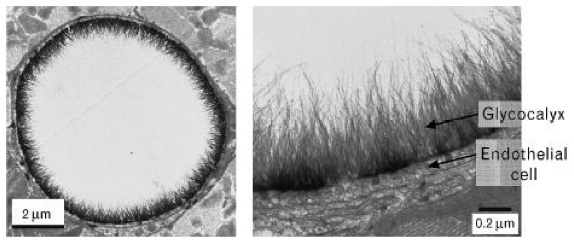
Now that it has been possible to study the glycocalyx, researchers have also been able to gain insight into what contributes to its degradation, and what must be done to keep it healthy. The most common sources of trouble are all too familiar: poor diet, lack of exercise, smoking. Dietary sugars and fats in the bloodstream have disastrous effects. Yet, notes Dr. DeSilva, studies have revealed that this delicate layer can rebuild itself if given the opportunity, though it can take up to 8 hours for the body to restore the glycocalyx after a high fat meal. Repeatedly consuming another high fat or high sugar meal before these structures are rebuilt causes the glycocalyx to get gradually thinner. But a smart diet and exercise can form a foundation to strengthen and rejuvenate the glycocalyx and endothelium. Research has further revealed that certain combinations of nutrients directly impact the body's ability to repair the glycocalyx, through natural production of heparan and nitric oxide.
Dr. DeSilva will discuss the biomechanical and chemical processes that govern continued healthy blood flow in more detail. He will also present a plan of action that can make a difference for your patients, allowing them to proactively restore and protect this elusive yet essential layer that, in turn, protects their blood vessels—and their hearts. He won't sugar-coat what they need to do...but the results could be sweet.